Why Pope Benedict XVI’s ‘Declaratio’ still haunts the Catholic Church
Scholars note that Benedict XVI specifically chose Latin to avoid mistakes – yet the published Declaratio contained multiple grammatical errors that were later quietly corrected.
Fri May 8, 2026 – 12:40 pm EDT(Nicholas Owen) —
For better or for worse, it remains the definitive moment for the Catholic Church of our time – the morning of February 11, 2013, when in the presence of the cardinals gathered for the consistory, Benedict XVI unexpectedly began reading aloud in Latin a document simply called Declaratio. The consequences of that utterance have been and still are enormous.Many assumptions have been made about what Benedict actually did that day. We would do well to go back to it, however we may feel about it, and re-evaluate what happened, paying attention to the facts, as well as brushing up on our Latin.
Fact one:
Pope Benedict spoke in Latin.In 2016, Peter Seewald asked Benedict in the book-interview Last Conversations to explain the choice of Latin:Seewald: “When and by whom was the text written that announced your resignation?”Benedict: “I wrote it. I cannot say exactly when, but at most two weeks prior.”Seewald: “Why in Latin?”Benedict: Because one does such an important thing in Latin. Furthermore, Latin is a language I know well so that I can write it in an elegant manner. I could have also written in Italian, of course, but there was the danger that I would make some mistakes.
So, Benedict affirms that he wrote in Latin because this statement was 1) important and 2) so important that he dare not risk making any mistake in it. Hold that thought.
Fact two:
The vernacular versions of the Declaratio published on the Vatican website distorted what Benedict said in Latin.Much ink has been spilt on this question elsewhere, but the most obvious indisputable example of this distortion is that the terms munus and ministerium were used interchangeably in a way unfaithful to the original pronouncement of Benedict in Latin, and in the German version the two terms – Amt for munus and Dienst for ministerium – were actually reversed.
The vernacular versions reprinted by the world media were simply not accurate translations of what Benedict XVI actually said that morning. This is all old news; among others, Antonio Socci extensively examined this question in his 2018 book The Secret of Benedict XVI: Why He Is Still Pope.
Fact three:
In addition, the Latin version of the Declaratio published on the Vatican website contained several errors.
This fact was immediately noted by Professor Luciano Canfora the very next day, February 12, 2013, when he lamented at Corriere della Sera that there was a Latin error right in the opening phrase, when Benedict said “pro ecclesiae vitae” instead of the correct “pro ecclesiae vita” to express that his Declaratio was of great importance “for the life of the church.” Note that even a first-year Latin student who has barely learned the first declension can explain why this is an error – because the preposition pro always takes the ablative case – and yet Benedict said he used Latin so as not to make any mistake. Something does not add up here.
Canfora was even more aghast at the use of the “intolerable accusative commissum,” saying that it obviously should have been the dative commisso in the phrase, “I renounce the ministry [ministerio] of Bishop of Rome … entrusted [commisso] to me by the Cardinals on April 19, 2005.”Canfora deplored the presence of such errors in “a text destined to pass into history” – errors due, he speculated, either to the author being disturbed or in a hurry – and surmised that it was probably the fault of some inattentive staff person. See his original Italian comments here.
Yet another error occurred in the official printed Latin version of the time the renunciation of the ministerium would take effect: hora 29 instead of hora XX or hora 20.These “mistakes” were eventually cleaned up on the Vatican website, but the fact that there were any at all, and especially an apparent “typo” on such a supremely important detail, is more than just sloppy, it’s… well, just completely bizarre.Here’s a screen shot of the Declaratio from February 14, 2013:
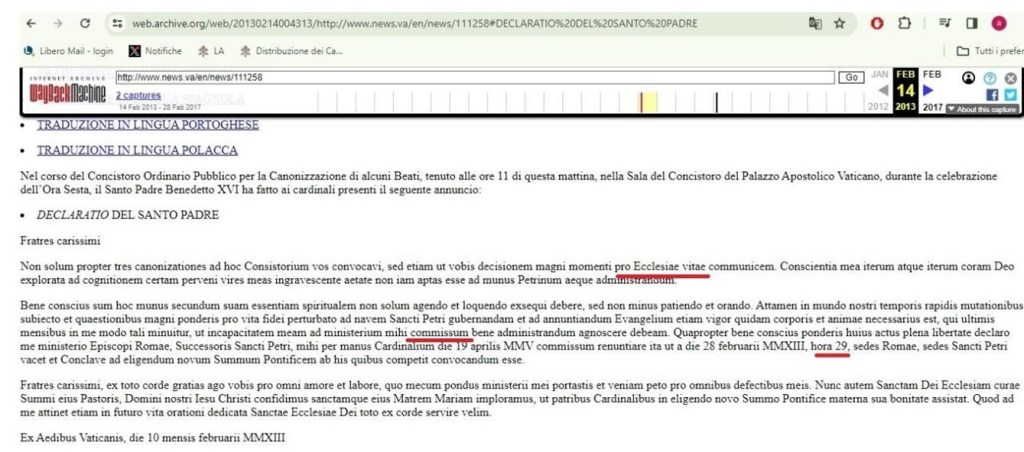
So, in February 2013 there were obviously distorted vernacular translations of the Declaratio as well as an “original Latin” version containing numerous errors that later got “cleaned up” (when exactly? by whom?) on the Vatican website.But hold on; there’s more…
Fact four:
The Latin spoken by Benedict XVI is different from the official published Latin text – specifically his use of the word commissum.
Props to Italian journalist Andrea Cionci for slowing down the video of Benedict reading his Declaratio from his original and authentic written version and listening word-for-word to what Benedict actually said that fateful morning. Watch and listen for yourself – Tutto papa Benedetto XVI dall’11 al 28 Febbraio 2013 – at the 0:12 mark you hear Benedict clearly say, correctly, “pro ecclesiae vita.” No supposed “mistake” there. And then, at the 1:30 mark, you can clearly hear Benedict say “commissum” – not “commisso.”
Hmm…
So Benedict. Who specifically chose to use Latin so as to avoid making any error, actually said commissum. Which begs the question – what if it was not Benedict who was in error but the people who think he made an error who are in error? What would the use of commissum in this sentence instead of commisso mean?
Fact five:
The Latin word commissum means crime.
Having noted that Benedict actually spoke the word commissum in his spoken Declaratio, Cionci asked the Latinists Gian Matteo Corrias and Rodolfo Funari to translate this same sentence using commissum instead of commisso.
Their conclusion is eye-popping:Declaro me ministerio Episcopi Romae … mihi per manus Cardinalium die 19 aprilis MMV commissum renuntiare…
“I declare that I renounce, to my own detriment [mihi], the ministry of the Bishop of Rome … on account of the crime [per “commissum”] of a band of Cardinals on April 19, 2005.”
The nature of this crime can and will be explored further, but the implication is that when Benedict was elected to the papacy in 2005 some sort of malevolent condition or ultimatum was placed on him that came home to roost in 2013.
But wait; there’s more – we have saved the best, the most theologically significant, for last.
Fact six:
The Latin word decisio does not primarily mean a “decision” but a “beheading” or “division.”
Benedict opens the Declaratio by telling the cardinals he has gathered them to tell them about a decisio that he has made. The modern reader of Latin is inclined to immediately equate “decisio” with a “decision” or “choice,” and hear Benedict saying, “I have gathered you today to inform you of a decision I have made.
”But “decision” is not the primary classical or even medieval implication of the feminine third declension noun decisio.
Take a spin through the Thesaurus Linguae Latinae and you will find that the first and most common synonym for decisio is decollatio – beheading – followed by partitio – a division into sections. (There is also a connection to pactio – agreement – and deminutio – diminishment, as in a diminishment of light.)
The first sentence of the Declaratio takes on an entirely new meaning in light of this fact:…
vos convocavi … ut vobis decisionem magni momenti pro Ecclesiae vita communicem.“
I have gathered you so that I may communicate to you a division – a beheading – a diminishment – of great importance for the life of the Church.”
A cutting off of the head of the Church from the body. An amputation to save the life of the Church.
If we then overlay this stunning image of a “great beheading” with what we know about Joseph Ratzinger’s life-long fascination with Tyconius’s eschatological understanding of what will happen to the Church in the end times, we can make yet another observation.
Remember, it was Joseph Ratzinger who wrote in 1956: “The Antichrist belongs to the Church, grows in her and with her until the great discessio, which initiates the final revelation.” Tyconius understood the discessio – Saint Jerome’s translation of Saint Paul’s word apostasian – spoken of in 2 Thessalonians 2:3 to be a necessary step that the Church must take if she is going to defeat the evil of the “false brethren”:
A withdrawal or dispersal of the faithful away from the evil hidden within the Church, so that the evil will come forth and reveal itself so that it may be defeated.
Again turning to the Thesaurus Linguae Latinae, we find that the first synonym for discessio is dissolutio unitatis – the dissolution of unity – followed by separatio, defectio, seditio – separation, defection, sedition. Understood in this sense, it is a partition, and thus akin to a decisio; indeed, the two words share the same etymology (de-caedere: to cut away – to cleave).
Decisio – a division, a cutting off. Discessio – a dissolution, a separation.
Knowing what we know about Joseph Ratzinger and his lifelong battle against the evil hidden within the Church, knowing that he believed that the Church could not win the battle if she passively deferred the struggle, but rather that the Church had to initiate the great discessio/separation from the evil within her in order to draw it out and defeat it, how could he not have borne all this in his mind when, on the morning of February 11, 2013, he stood before the College of Cardinals, filled with his enemies, and declared to them:
… vos convocavi … ut vobis decisionem magni momenti pro Ecclesiae vita communicem.
“I have gathered you so that I may communicate to you the DISCESSIO of great importance for the life of the Church.”
The Great Discessio is an eschatological moment.
According to this reading, it occurred on February 11, 2013.Can anyone deny that, since that day, nothing has been the same?
“Let the one who has an ear hear what the Spirit is saying to the churches.” –
Revelation 3:13
My Comment : What a huge article, congratulations to the author. It’s all there !
The Pope, using Latin for his historic declaration of resignation—a language he knew perfectly—probably made some glaring grammatical errors to send an eschatological message to those who can read between the lines, confirming that he had to resign out of necessity because the forces of the Antichrist were already within the Church, and the most fascinating part below
Yet another error occurred in the official printed Latin version of the time the renunciation of the ministerium would take effect: hora 29 instead of hora XX or hora 20.These…..
hora 29 instead hora 20, read between the lines the year 2029 probably related the Fatima 3rd Secret for sure, we are there !
Aviso


« WE MUST MOVE FORWARD » is utterly shocking words from our so called Shepherd of the Roman Catholic Church! That comment speaks volumes, he wants change! God help us, we will be a small remnant faith BUT under our lady’s mantle of protection. Buckle up! 🙏🏻
LikeLike
https://www.lifesitenews.com/opinion/heres-why-benedicts-declaration-continues-to-cast-doubt-on-francis-legitimacy/?utm_source=most_recent
Here’s why Benedict’s declaration continues to cast doubt on Francis’
LikeLike
SSPX responds to Vatican threats with profession of faith
https://www.lifesitenews.com/news/breaking-sspx-responds-to-vatican-threats-with-profession-of-faith/?utm_source=popular
My Comment : Blessed is your Name in Heaven SSPX, thank you Brothers in Christ, thank you Soldiers of Christ !
LikeLike
DICASTERY FOR THE DOCTRINE OF THE FAITH
Statement of His Eminence Cardinal Víctor Manuel Fernández,
Prefect of the Congregation for the Doctrine of the Faith
With regard to the Priestly Fraternity of Saint Pius X, we reiterate what has already been communicated. The episcopal ordinations announced by the Priestly Fraternity of Saint Pius X do not have the requisite papal mandate. This act will constitute “a schismatic act” (John Paul II, Ecclesia Dei, no. 3) and “formal adherence to the schism constitutes a grave offence against God and entails the excommunication established under Church law” (ibid., 5c; cf. Pontifical Council for Legislative Texts, Explanatory Note, 24 August 1996).
The Holy Father continues in his prayers to ask the Holy Spirit to enlighten those responsible for the Priestly Fraternity of Saint Pius X so that they may reconsider the extremely grave decision they have taken.
From the Vatican, 13 May 2026
Holy See Press Office Bulletin, 13 May 2026
https://www.vatican.va/roman_curia/congregations/cfaith/documents/rc_ddf_doc_20260513_dichiarazione-fernandez-fsspx_en.html
My Comment : This evil and heretical Cardinal chose May 13th, the first Apparition day of our Lady in Fatima, to make this announcement, like a wink to the devil !
LikeLike
SSPX profession of faith strengthens criticisms of Vatican II but raises new questions
The SSPX’s 154-point ‘Profession of Faith’ covers an extraordinary, wide range of Catholic doctrines.
https://www.lifesitenews.com/analysis/sspx-profession-of-faith-strengthens-criticisms-of-vatican-ii-but-raises-new-questions/?utm_source=most_recent
LikeLike
Fatima and the Liturgical Revolution
My Comment : Schism is on the way, I am going to stay with Father Gruner and our Lady of Fatima, thank you !
https://fatima.org/video/fr-gruners-top-10-fatima-and-the-liturgical-revolution/
LikeLike