The Vatican’s new document on inter-religious dialogue downplays evangelization and rejects ‘a closed view of reality’ and ‘the defensive entrenchment in one’s own position.
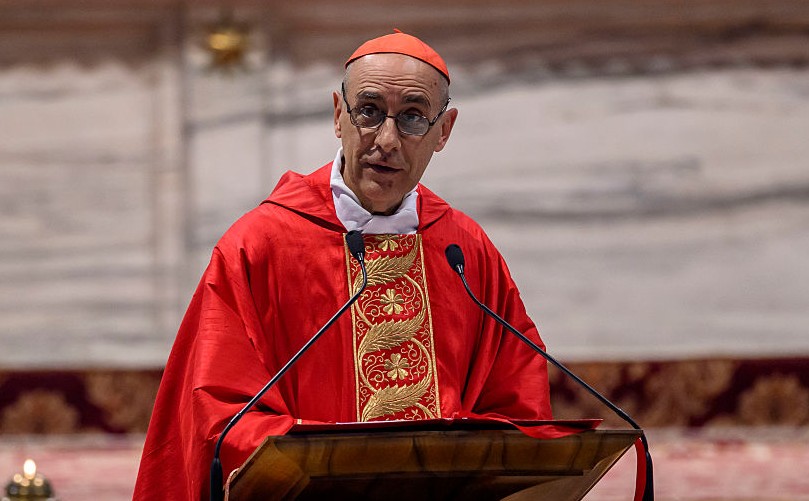
The Vatican has asked Catholics to ‘esteem’ other faiths in its latest document on interreligious dialogue and “fraternity.”The document, signed by Cardinal Víctor Manuel Fernández, Prefect of the Dicastery for the Doctrine of the Faith (DDF); Cardinal Kurt Koch, Prefect of the Dicastery for Promoting Christian Unity; and Cardinal George Jacob Koovakad, Prefect of the Dicastery for Interreligious Dialogue, appeared this morning.Entitled “A Journey of Hope:
Sixty Years of Interreligious Dialogue and Fraternity in the Light of the Conciliar Declaration Nostra Aetate,” the text discourages “proselytism,” that is, attempts to convert people of other religions.
“The defensive entrenchment in one’s own position and the view that proselytism is the only way to engage with the other no longer make sense in a world that increasingly resembles an interconnected and constantly evolving global village,” it states.
The document upholds “interreligious dialogue” and “fraternity” with other religions as an ideal, but frames these as means towards “peace” and “understanding,” as opposed to evangelization.What does dialogue mean, according to the text?
“To engage in dialogue in the spirit of , therefore, presupposes a contemplative gaze directed toward the ‘other who is different.’ ‘Approaching, speaking, listening, looking at, coming to know and understand one another, and to find common ground: all these things are summed up in the one word ‘dialogue.’”
Evangelization, conversion, and bringing one towards Christ are not cited in this conception of dialogue.The document further explicitly differentiates “dialogue” from Christian evangelization, more clearly implying that the Vatican’s idea of interreligious dialogue does not involve evangelization.“To those who might be tempted to insist exclusively on the obligation to proclaim Christ, they recall that also affirms the necessity of dialogue with other religious traditions, since such dialogue is now ‘a part of the Church’s evangelizing mission,’” the text states.
The text cites Pope Francis’ affirmation that such dialogue is “a necessary condition for peace in the world, and so it is a duty for Christians as well as other religious communities.”So-called “fraternity” itself is also a stated goal, independent of any effort to convert others to Christianity. The document encourages “constant dialogue with cultures, religions, and consciences” that is ultimately “directed toward fraternity.
In “building human fraternity,” what matters for each religion is not that they adhere to the truth, but that they embrace the “poor” and “wounded”:
“Hence arises the importance of a universal criterion of discernment that can be found in the sacred texts of the various religions: namely, whether one welcomes or rejects the wounded person lying by the roadside.
Concrete concern for the most vulnerable is the essential measure by which the integrity of every project—whether political, economic, social, academic, religious, or cultural—must be judged. The poor, in all the forms their vulnerability may take, are the compass that allows us to know whether we are moving in the right direction.
”Moving forward, the document declares that our religious goal should be not to establish a “one great world religion in which all beliefs are flattened,” but to build “a fraternal society capable of accepting differences.” That is, Catholics must accept that their neighbors espouse error.
“This intention remains at the heart of interreligious dialogue,” it adds.
The document even suggests that adhering to dogma involves a “closed view of reality” that becomes a source of “suffering.”
“Monolithic and isolated models, which encourage a closed view of reality, are proving increasingly inadequate and, ultimately, become sources of violence and suffering for the most vulnerable,” it claims.
The DDF’s text goes so far as to declare that different, erroneous religions have “special gifts” that they do not have to part with: “In this regard, religions, like universities, have much to offer, without having to renounce their specific character and special gifts.
”Thus, by all indications, the document endorses religious indifferentism, which was condemned by Pope Gregory XVI, by Pope Pius IX in his Syllabus of Errors, and by other popes.
In this regard, the DDF text contradicts Church magisterial teaching.
My Comment :
This article adopts a traditionalist and critical framing that contrasts current Vatican diplomatic and pastoral efforts with the classic dogma “Outside the Church, there is no salvation” (Extra Ecclesiam nulla salus).
1. What the Dogma “Outside the Church, There Is No Salvation” Asserts :
Historically defined by the Fourth Lateran Council and the Council of Florence, this dogma affirms that eternal salvation comes through Jesus Christ and His mystical body, the Church. In its strictest, literal interpretation, no one outside the visible boundary of the Catholic Church can be saved.
2. The Official Magisterial Position (Vatican II to Present)
Since the Second Vatican Council—specifically through documents such as Nostra Aetate (1965), the Catechism of the Catholic Church, and Dominus Iesus (2000)—the Magisterium distinguishes between two key principles:
The Necessity of Christ and the Church:
The Church maintains that all salvation originates from Christ through the Church.
Why the Article Alleges a Contradiction ?
The LifeSiteNews piece accuses the Vatican document of departing from dogma because it:
Emphasizes interreligious dialogue and human fraternity while downplaying direct evangelization and conversion efforts.
Appears to border on religious indifferentism (the belief that all religions are equally valid pathways to God), a concept explicitly condemned by prior popes (such as Gregory XVI and Pius IX).
So who is right: Church tradition or the post-Vatican II Church?
Determining who is strictly ‘right’ is a matter of personal faith and theological conviction. The answer depends entirely on the framework of authority and the interpretation of tradition one adopts.
Here is how both perspectives are framed:
From the Perspective of the Church’s Magisterium (The Post-Vatican II Position)
For the current Catholic Church, the post-Vatican II Church is correct, operating on the principle of the ‘Living Magisterium.’* Continuity of Dogma: The Vatican maintains that there is no rupture or contradiction with the past, but rather a ‘development of doctrine’ (what Pope Benedict XVI called the ‘hermeneutic of reform in continuity’).
The Explanation: The dogma Extra Ecclesiam nulla salus remains true, but its understanding has deepened. Affirming that salvation comes through the Church does not mean God cannot extend His grace to a person of good will who has never known Catholicism. For today’s Magisterium, engaging in dialogue with other cultures and religions expresses Christian charity rather than a denial of truth.
From the Perspective of Tradition (The Traditionalist Position)
For proponents of strict tradition, the pre-conciliar doctrine is correct, relying on the immutability of revealed truth.* Unchanging Faith: Under this view, divine truth revealed by Christ cannot change over centuries or adapt to modern secular frameworks.
The Explanation: 19th- and early 20th-century Popes (such as Pius IX and Pius X) explicitly condemned religious indifferentism—the idea that salvation can be found equally in any religion. Traditionalists argue that downplaying evangelization in favor of social dialogue or universal fraternity risks misleading souls about the necessity of conversion.
Key Takeaway*
Following institutional authority and theological development under successive popes establishes the post-Vatican II position as today’s official norm.* Prioritizing a strict historical reading of older magisterial texts makes the current approach appear as a shift or contradiction.This fundamental disagreement forms the core debate within contemporary Catholicism.
Source : Gemini
“In Portugal the dogma of the Faith will always be Preserved…etc….”
Aviso
 Garabandal News
There is only one God and His name is Jesus Christ. The Father when he gave His Commandments to His people, clearly stated, THOU SHALT HAVE NO OTHER GODS BEFORE ME
LikeLiked by 1 person