May 24, 2016
Archbishop Gänswein: Benedict XVI Sees Resignation as Expanding Petrine Ministry
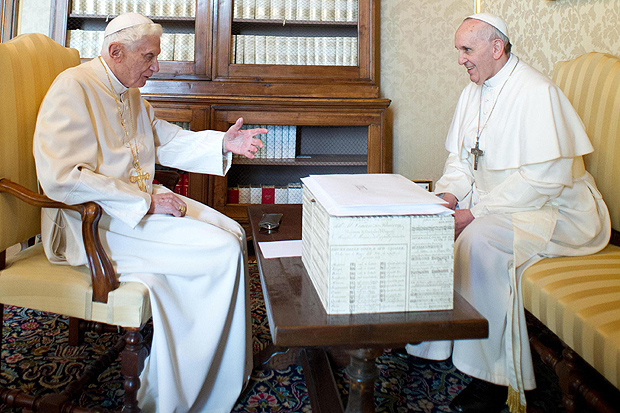
In a speech reflecting on Pope Benedict XVI’s pontificate, Archbishop Georg Gänswein has confirmed the existence of a group who fought against Benedict’s election in 2005, but stressed that “Vatileaks” or other issues had “little or nothing” to do with his resignation in 2013.
Speaking at the presentation of a new book on Benedict’s pontificate at the Pontifical Gregorian University in Rome May 20, Archbishop Gänswein also said that Pope Francis and Benedict are not two popes “in competition” with one another, but represent one “expanded” Petrine Office with “an active member” and a “contemplative.”
Archbishop Gänswein, who doubles as the personal secretary of the Pope Emeritus and prefect of the Pontifical Household, said Benedict did not abandon the papacy like Pope Celestine V in the 13th century but rather sought to continue his Petrine Office in a more appropriate way given his frailty.
“Therefore, from 11 February 2013, the papal ministry is not the same as before,” he said. “It is and remains the foundation of the Catholic Church; and yet it is a foundation that Benedict XVI has profoundly and lastingly transformed by his exceptional pontificate.”
Reflecting on Benedict’s time as Pope, Archbishop Gänswein said that although he was “a classic ‘homo historicus’, a Western man par excellence who embodied the richness of the Catholic tradition like no other,” at the same time he was “so bold as to open the door to a new phase, for that historic turning point that five years ago no one could have imagined.”
Gänswein drew attention to “brilliant and illuminating” and “well documented and thorough” passages of the book, written by Roberto Regoli and entitled Oltre la crisi della Chiesa. Il pontificato di Benedetto XVI — “Beyond the Crisis of the Church, The Pontificate of Benedict XVI.”
The German prelate especially highlighted Regoli’s account of “a dramatic struggle” that took place in the 2005 Conclave between the “so-called ‘Salt of the Earth Party’” (named after the book interview with Cardinal Joseph Ratzinger) comprising “Cardinals Lopez Trujillo, Ruini, Herranz, Ruoco Varela or Medina” and their adversaries: “the so-called St. Gallen group” that included “Cardinals Danneels, Martini, Silvestrini or Murphy O’Connor” — a group Cardinal Danneels referred jokingly to as “a kind of mafia-club,” Archbishop Gänswein recalled. (His reference to that struggle backs up an interview German journalist Paul Badde gave the Register last November and EWTN Germany, during which Badde also mentioned German Cardinals Kasper and Lehmann as being part of the St. Gallen group).
“The election was certainly the outcome of a battle,” Gänswein went on, adding that the “key” to the Conclave was Cardinal Ratzinger’s “dictatorship of relativism” homily that he gave on the first day of the election when he was Dean of the College of Cardinals.
Benedict’s personal secretary then referred to how Regoli highlights the “fascinating and moving” years of Benedict’s pontificate, and his “skill and confidence” in exercising the Petrine ministry. He recalled, in particular, the “black year” of 2010, when Manuela Camagni, one of the four Memores Domini consecrated women who assisted Benedict, was tragically killed in a road accident in Rome.
The year, which he attests was a dark one, was further blackened by “malicious attacks against the Pope” and the fallout from Benedict’s lifting of the excommunication on Bishop Richard Williamson who denied the extent of the Holocaust.
But nothing affected Benedict’s “heart as much as the death of Manuela”, whom he considered part of the “papal family” of helpers. “Benedict wasn’t an ‘actor pope’, and even less an insensitive ‘automaton Pope’,” Gänswein said. ”Even on the throne of Peter, he was and remained a man… ‘a man with his contradictions’.”
Then, after having been so affected by the death of Camagni, Benedict suffered the “betrayal of Paolo Gabriele”, his “poor and misguided” former valet who was found guilty of leaking confidential papal documents in what became known as the ‘Vatileaks’ scandal. That episode was “false money” traded on the world stage as “authentic gold bullion” he said, but stressed that “no traitor, ‘mole’, or any journalist” would have caused Benedict to resign. “The scandal was too small” for the “greater, well considered step Benedict made of millennial historical significance.”
Such assumptions that they did have something to do with it, he said, “have little or nothing to do with reality”, adding that Benedict resigned because it was “fitting” and “reasonable”, and quoted John Duns Scotus’ words to justify the decree for the Immaculate Conception: “Decuit, potuit, fecit” — “He could do it, it was fitting that He do it.”
Various reports have suggested that pressure was exerted on Benedict to step down. One of the latest came last year from a former confidant and confessor to the late Cardinal Carlo Martini who said Martini had told Benedict: “Try and reform the Curia, and if not, you leave.”
But in his speech, Gänswein insisted “it was fitting” for Benedict to resign because he “was aware that the necessary strength for such a very heavy office was lessening. He could do it [resign], because he had long thought through, from a theological point of view, the possibility of a pope emeritus in the future. So he did it.”
Drawing on the Latin words “munus petrinum” — “Petrine ministry” — Gänswein pointed out the word “munus” has many meanings such as “service, duty, guide or gift”. He said that “before and after his resignation” Benedict has viewed his task as “participation in such a ‘Petrine ministry’.
“He left the Papal Throne and yet, with the step he took on 11 February 2013, he has not abandoned this ministry,” Gänswein explained, something “quite impossible after his irrevocable acceptance of the office in April 2005.“
Instead, he said, “he has built a personal office with a collegial and synodal dimension, almost a communal ministry, as if he had wanted to reiterate once again the invitation contained in the motto that the then-Joseph Ratzinger had as Archbishop of Munich and Freising and naturally maintained as Bishop of Rome: “cooperatores veritatis”, which means ‘co-workers of the truth’.”
Archbishop Gänswein pointed out that the motto is not in the singular but in the plural, and taken from the Third Letter of John, in which it is written in verse 8: “We must welcome these people to become co-workers for the truth”.
He therefore stressed that since Francis’ election, there are not “two popes, but de facto an expanded ministry — with an active member and a contemplative member.” He added that this is why Benedict XVI “has not given up his name”, unlike Pope Celestine V who reverted to his name Pietro da Marrone, “nor the white cassock.”
“Therefore he has also not retired to a monastery in isolation but stays within the Vatican — as if he had taken only one step to the side to make room for his successor and a new stage in the history of the papacy.” With that step, he said, he has enriched the papacy with “his prayer and his compassion placed in the Vatican Gardens.”
Archbishop Gänswein repeated that Benedict’s resignation was “quite different” to that of Pope Celestine V.
“So it is not surprising,” he said, “that some have seen it as revolutionary, or otherwise as entirely consistent with the gospel, while still others see in this way a secularized papacy as never before, and thus more collegial and functional, or even simply more humane and less sacred. And still others are of the opinion that Benedict XVI, with this step, has almost — speaking in theological and historical-critical terms — demythologized the papacy.”
Source : ncregister.com
My Comment : So is it possible to have 2 Popes ? of course not, Papacy institued by Christ is held by one man and cannot be split between 2 men, thinking the opposite would be heresy, more in the attached videos.
May 30, 2016
2 Popes ? Part II
What Is Monsignor Ganswein Up To?
by Christopher A. Ferrara
May 30, 2016
During his recent presentation of the book Beyond the Crisis in the Church: The Pontificate of Benedict XVI, Monsignor Georg Ganswein, who serves as personal secretary to “Pope Emeritus” Benedict XVI, inexplicably and quite mysteriously provided new depth, and thus new impetus, to the novel idea that Benedict’s renunciation of the papacy was qualified by a “changed understanding” of the papacy, according to which Benedict retained a “passive” aspect of the Petrine office while turning over its active exercise to Francis.
In the course of the book presentation Ganswein made remarks that surely reflect Benedict’s own understanding of his situation, including the precise meaning of the text of the renunciation, carefully phrased to refer to “the ministry of the Bishop of Rome, successor of Saint Peter”. It is inconceivable that Ganswein would merely have offered his own opinion on the matter without having consulted Benedict.
According to Ganswein, while “there are not two Popes” as a result of the renunciation, there is nevertheless “a sort of exceptional state willed by heaven” according to which “the papal ministry is no longer what it was before…” Rather, Benedict “has profoundly and lastingly transformed it” such that “he has not abandoned the office of Peter [but] has instead innovated this office” so that there is “de facto a broadened ministry — with an active member [Francis] and a contemplative member [Benedict].”
Antonio Socci notes that only two conclusions are possible here: one nonsensical and the other of momentous significance. The first conclusion, as Socci writes, is that Benedict has created a “momentous turning point that in fact involves a radical mutation of the papacy, which today has become a collegial organ (but this is impossible according to Catholic doctrine).” Indeed, it is impossible, and so the very contention is absurd. No matter what Benedict thinks he has done, no Pope has the power to change the nature of an office established in perpetuity by God Incarnate. That is, no Pope has the power to alter the divine constitution of the Church. As even John Paul II remarked when he was about to undergo major surgery: “You have to cure me because there is no room for a pope emeritus.”
The other conclusion, says Socci, is that “this discourse [by Ganswein] brings into view the ‘nullity’ of the renunciation by Benedict XVI.” Indeed, if Benedict’s renunciation of the papacy was premised on his false opinion that he would remain a “contemplative member” of a “broadened” Petrine office by way of an innovation he himself had just originated, then how could the validity of that qualified renunciation not be called into question? Is it not the case that Benedict still regards himself as the Pope in some sense? And if that is so, how can he be said to have renounced the papacy unequivocally?
Indeed, as Ganswein observed: “For this reason, Benedict has renounced neither his name, nor the white cassock. For this reason, the correct appellation by which he refers to himself, even today, is “Holiness”; and for this reason, moreover, he did not retire to a remote monastery, but within the Vatican…”
I offer no answer to the question how this utter novelty affects Benedict’s renunciation of the papacy. That is something history will have to judge — if indeed there is anything to judge. I offer only another question: Why is Monsignor Ganswein pressing this point now, three years into the tumultuous pontificate of Pope Francis? Surely these remarks were well considered beforehand. So what is he up to?
A clue is found in Ganswein’s startling reference to the treachery at work in the conclave of 2005, during which the so-called “St. Gallen mafia,” including the infamous Cardinals Danneels and Kasper, contrived to elect Cardinal Bergoglio. Amazingly, Ganswein refers to this development as simple historical fact, observing that the 2005 conclave involved “a dramatic struggle between the ‘Salt of the Earth’ party [of Ratzingerian orientation], revolving around Cardinals López Trujíllo, Ruini, Herranz, Rouco Varela and Medina, and the ‘Saint Gallen group’, revolving around Cardinals Danneels, Martini, Silvestrini and Murphy-O’Connor…”
Ganswein then ties the struggle at the conclave to two other telling facts: First, Cardinal Ratzinger’s homily at the conclave’s inception wherein he decried the “dictatorship of relativism which does not recognize anything as definitive and views as the ultimate measure its own self and its own will.” Second, Pope Benedict’s request, immediately after his unexpected election, that the faithful pray for him that he not “flee in fear of the wolves.”
This is really quite remarkable: All in all, Ganswein’s remarks suggest that Benedict’s papacy was under attack by evil forces from beginning to end. He makes that clear when he scoffs at the idea that anything as trivial as “Vatileaks” could have forced Benedict out of office: “That scandal was too small for a thing of that kind and something much greater [prompted] the carefully considered step of millennial historic importance that Benedict took.”
Make of it what you will. But do not underestimate the significance of Ganswein’s remarks in the midst of what is clearly the most disturbing papacy in the living memory of the Church: that of Benedict’s successor under mysterious and unprecedented circumstances.
Source : Fatima.org
Aviso
 Garabandal News
From Keeping it Catholic :
MISLEADING TITLE: The heretical opinions expressed in this article are those of Archbishop Gänswein—*not* Bishop Emeritus Benedict XVI.
In effect: Gänswein is stating that Benedict’s resignation was only a way of *redefining* the papacy. For example, Gänswein dared to say: “Therefore, from 11 February 2013, the papal ministry is not the same as before. It is and remains the foundation of the Catholic Church; and yet it is a foundation that Benedict XVI has profoundly and LASTINGLY TRANSFORMED by his exceptional pontificate.” [Emphasis added.]
NO. The office of the papacy, instituted by Christ, is held by *one* man. The papacy *cannot* be split between two men—one in “active” ministry and another in “contemplative.”
LikeLike